
How to Check for a Warrant in Kenedy County
Kenedy County runs no public countywide warrant search, so begin with the court named on your citation, notice, or case paper. A justice-court matter goes to the right JP precinct. A felony may belong to the 105th District Court and its District Clerk, and the County Court keeps its own criminal docket. The Sheriff's Office is the published local law-enforcement contact. Its website posts no warrant list and staffs no dedicated warrant line. Texas also offers no statewide public warrant lookup. When you call, give your own full name and your cause or citation number. Ask which court issued the process, whether it is still active, and what the next step is. The county's warrant-search channels are office contacts and written requests rather than one results page. DPS can explain a license hold, but it cannot confirm a warrant. Write down the date and the instructions you get, and ask what authorization a relative would need.
- Read the notice for the issuing court, precinct, cause number, and next court date.
- Call that JP, County Court, or the District Clerk and ask for your own current case status.
- Call the Sheriff at 361-294-5205 for service or custody instructions.
- Use the Kleberg roster linked from the Sheriff only to check possible custody, not warrant status.
- If a document is needed, make a narrow written Texas Public Information Act request and keep proof of delivery.
Kenedy County JP Warrant Contacts
Kenedy County's official Justice page lists four precinct courts, each with its own phone and payment route. Pick the precinct printed on the citation before you call. These offices handle many traffic and Class C cases. The online payment links, though, do not return warrant status. The page itself is a four-office directory, not a warrant database.
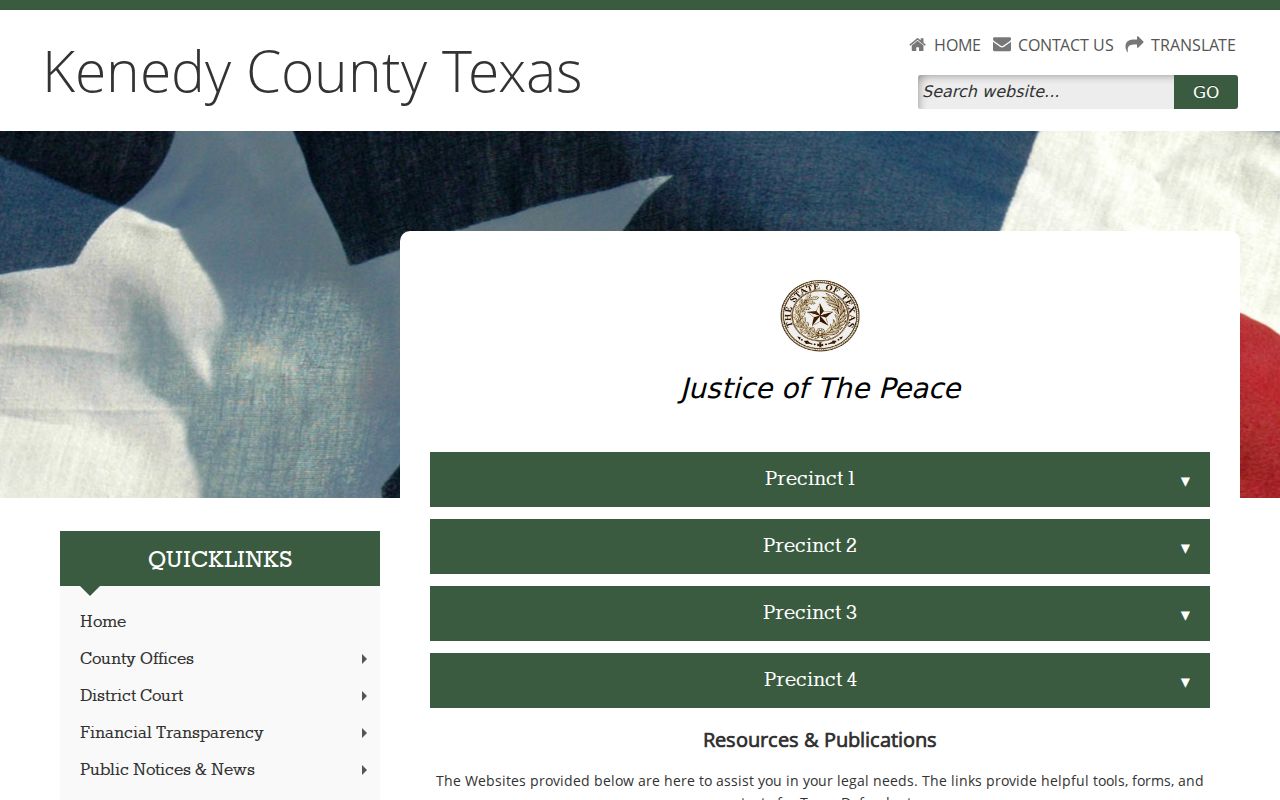
Three of the four Kenedy County JP courts list La Parra Avenue: JP1, JP3, and JP4. JP2 sits at 139 N Main Street. The JP1 GovPay header conflicts with the directory, so call that court to confirm the filing location.
Types of Warrants in Kenedy County
Different papers, different jobs. In Kenedy County, an arrest warrant follows a sworn complaint and a magistrate's review. JP cases may turn on a capias or capias pro fine once a date is missed or a judgment goes unpaid. A search warrant lets officers search, not arrest. It also carries separate access rules. A license hold is a related consequence, not a warrant type at all.
| Warrant Type | How It Arises | Who Issues It |
|---|---|---|
| Arrest warrant | Magistrate finds probable cause on a sworn complaint. | Magistrate, JP, County Court, or District Court as authorized. |
| Bench process | Missed appearance or other court noncompliance. | The court handling the case. |
| Search warrant | Probable cause supports a search of a place or property. | Magistrate under Chapter 18. |
| Capias pro fine | Unpaid fine or costs under justice-court procedure. | Issuing JP or court. |
Search warrants run under Chapter 18. Juvenile warrant papers carry Family Code Chapter 58 protections, and federal matters go the Southern District of Texas route. A DPS license hold is not a warrant, anywhere in Kenedy County or beyond.
Kenedy County Warrant Payment Portals
Kenedy County's four GovPay pages are payment forms, not search tools. JP1, JP3, and JP4 ask for a name and case number; JP2 asks for an account number. None of them shows a case result, warrant status, or recall confirmation. Take the official-linked JP1 payment page: it asks for case details and payment information and nothing more. That transaction prompt is all it shows, and a completed payment is not proof that court process has been withdrawn.
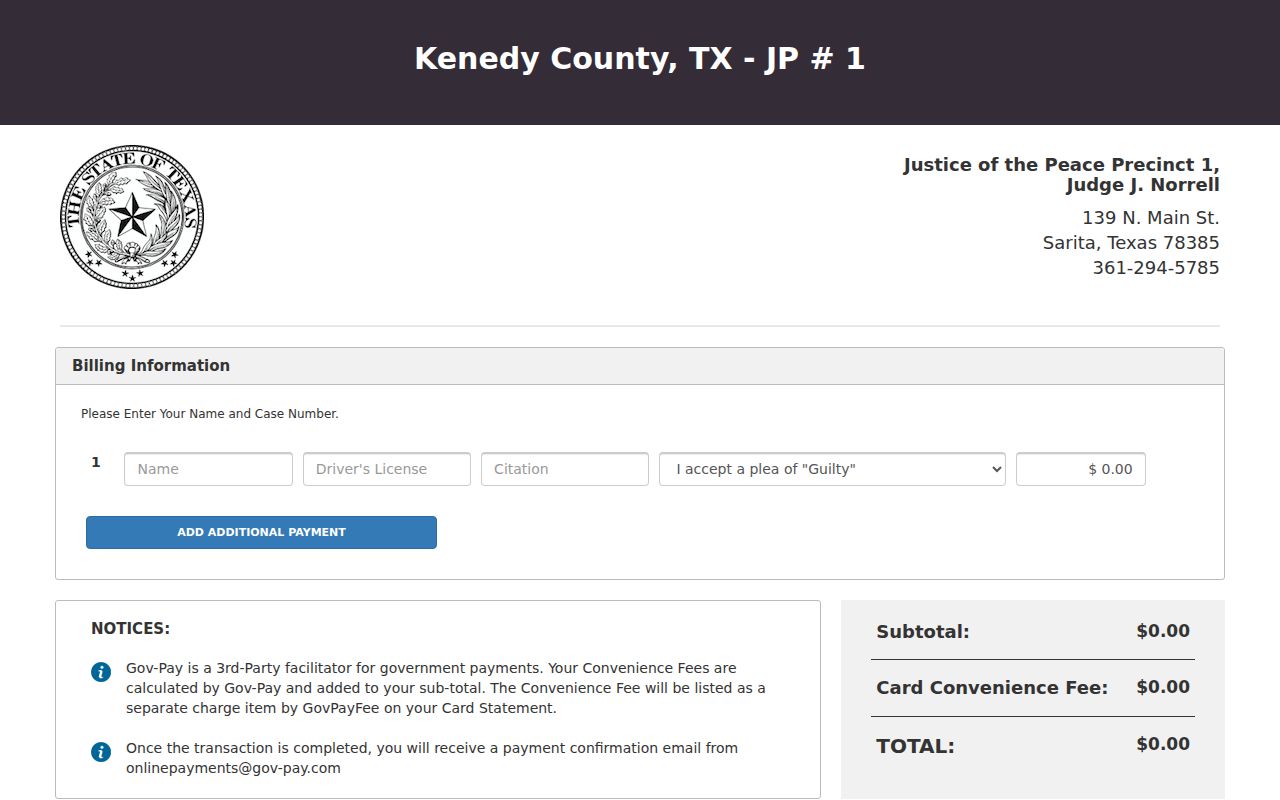
Call the issuing JP before sending money. That matters most when a failure to appear or capias may already exist. All four vendor pages accept card or ACH details and post transaction terms. The card convenience fee is listed at 2.50 percent with a $3 minimum, marked nonrefundable, and transaction fees show separately. Those charges are payment costs in Kenedy County, not the court's bond amount and not proof a case is closed.
What a Kenedy County Warrant Record Shows
Kenedy County publishes no sample warrant entry and no local field guide. A real court record may tie the process to a cause or citation number, the issuing court, the offense, the date, bond terms, and later service or recall notes. The exact fields depend on the court and the record type, so treat this outline as a map, not a copy of anyone's file. Ask the issuing office to confirm the record and explain its status labels before you rely on them.
| Warrant Number | Local format not published |
|---|---|
| Subject Name | Identity details belong in a direct, authorized status check. |
| Charge / Offense | The case record may name the alleged offense and governing court. |
| Issuing Court | Confirm whether the JP, County Court, or 105th District Court controls the case. |
| Bond Amount | Ask the court or jail; a fee is not the same as bail. |
| Status | Issued, served, recalled, or cleared must be confirmed with the office. |
Kenedy County posts no warrant-number format and no status dictionary. A JP plea form's cause number may not match a warrant identifier. Ask which existing document is available and whether redactions apply.
Kenedy County Warrant Status Needs Confirmation
The Kenedy County Sheriff page links to a Kleberg County custody roster. That neighboring roster can tell you whether someone may be in custody, but it does not list every Kenedy County warrant, and it cannot decide whether a court recalled process. Court records and jail rosters answer different questions. A blank roster proves little. So does a payment receipt or a license hold. If you need a current answer on warrant status, ask the issuing court first, then ask the Sheriff about service instructions if the court sends you there. The Kleberg roster may also omit someone never booked there or already released. Keep custody and court status separate.
Who Issues and Serves Kenedy County Warrants
Courts issue process, and authorized peace officers execute it. The 105th District Court serves Kenedy, Kleberg, and Nueces counties from its Kingsville location, while Kenedy County's JP courts handle many Class C and traffic matters. The county publishes no current constable roster and no direct warrant-unit line. The Sheriff page offers a contact route for Kenedy County, not an online warrant search.
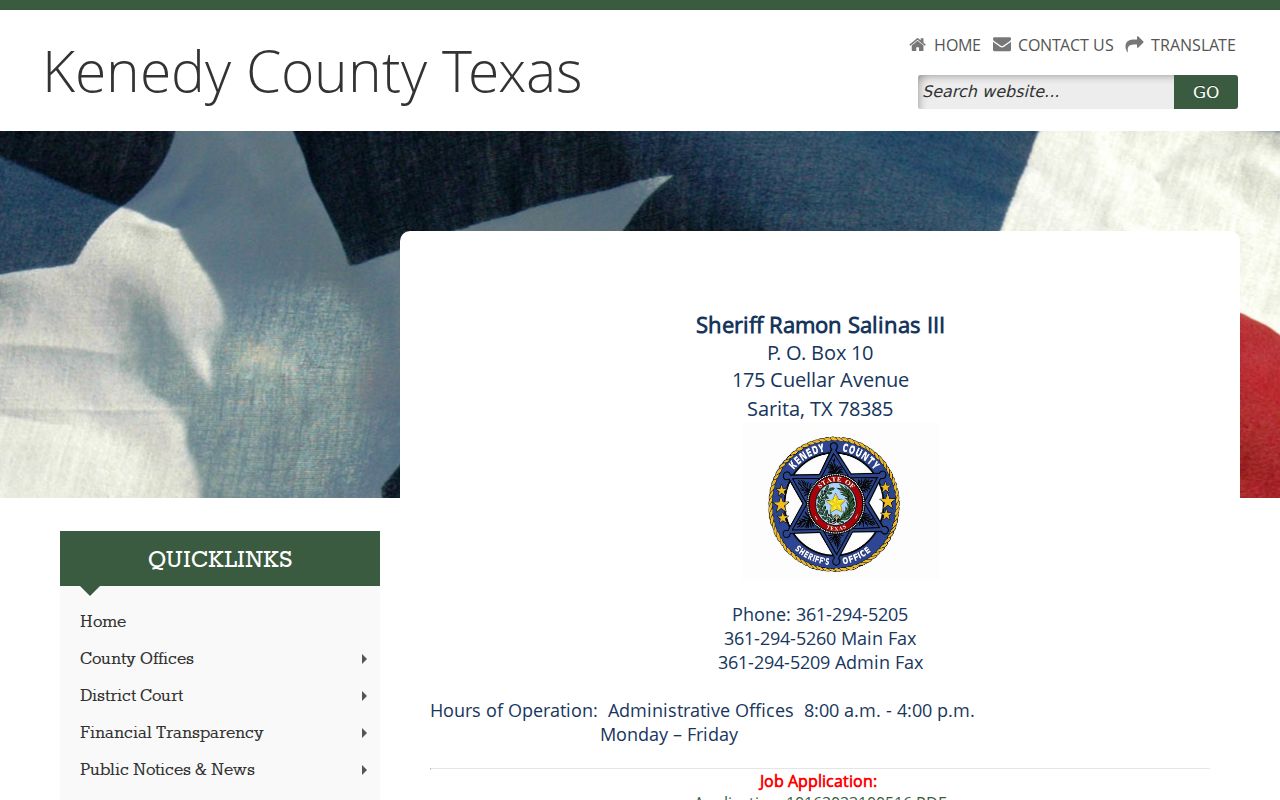
The Kenedy County Sheriff is Ramon Salinas III, reachable at 361-294-5205. The office sits at 175 Cuelar Avenue. Administrative hours run Monday through Friday, 8:00 a.m. to 4:00 p.m. Kenedy County publishes no warrant sergeant, direct warrant line, or public warrant email, and its site lists no current constable roster.
Requesting Kenedy County Warrant Documents
A written request under the Texas Public Information Act is the way to seek an existing warrant document, or a count that names no one. Spell out the office, the cause or citation number, the date range, and the electronic format you prefer. The Sheriff takes mail at P.O. Box 10, Sarita, TX 78385. Hand delivery goes to 175 Cuelar Avenue, and calling ahead is wise, since Kenedy County offers no request email or portal. Keep proof of delivery. Skip any request for a roster naming other people. The Texas Public Information Act permits exceptions, and some investigative material falls outside disclosure. The Attorney General's optional form walks you through the description, dates, response method, and format. A governmental body must respond promptly. Within ten business days it must take one of the actions the law requires, subject to the request and any exceptions.
What to Do If You Have a Kenedy County Warrant
Start by learning which court issued the process and what kind it is. With the cause number in hand, call the issuing JP, County Court, or District Clerk and ask what the court wants: a hearing, an attorney motion, a payment plan, bond, or a simple appearance. The Sheriff can explain service and custody directions. What it cannot do is change a court's judgment. Kenedy County publishes no local motion-to-recall form and runs no walk-in warrant docket. For a felony, or any disputed status, talk to a Texas attorney before you show up. After a payment or hearing, get the court's own confirmation that the warrant was recalled or satisfied. Ask too whether a DPS update is still pending.
Important: Ask an attorney and the issuing court how to appear or post bond; a walk-in can lead to booking and is not a guaranteed recall.
Kenedy County Traffic Warrants
Kenedy County justice-court paperwork shows how a traffic ticket hardens into a warrant. The Pct. 4 plea form warns that skipping court adds a failure-to-appear charge, a warrant, and a hold on driver-license renewal. Pct. 3's opt-out form ties unpaid fines and a missed show-cause hearing to a capias pro fine. Pct. 1 goes the other way. It lists judge-approved payment plans, community service, jail credit, and financial-disclosure review. Each route needs the court's sign-off and documentation. Paying alone does not recall a warrant. The traffic warrant page walks through those forms and explains the separate DPS hold.
Public Access to Kenedy County Warrant Records
Two Texas laws govern public access to Kenedy County warrant records. Government Code Chapter 552 sets the rules for public-information requests to county offices, with exceptions. Code of Criminal Procedure Article 15.26 covers public access to an executed arrest warrant and its supporting affidavit. Active investigations, sealed files, and juvenile records stay limited.
Key Rules:
Texas Government Code Chapter 552 sets the public-information request process and its exceptions.
Code of Criminal Procedure Article 15.26 addresses access after an arrest warrant is executed.
Texas Family Code Chapter 58 protects juvenile warrant complaints and affidavits from general public release.
Chapter 18 governs search-warrant affidavits. Article 15.26 covers an executed arrest warrant and its affidavit, while investigative, sealed, or juvenile material may stay protected in Kenedy County. Ask for one specific record. Expect redactions where the law requires them.
Kenedy County Warrant Courts and Locations
Sarita holds the county seat, yet not every court serving Kenedy County sits there. Shared 105th District Court in Kingsville handles district-level felony matters. The District Clerk's Sarita office can sort out the case route before you drive. Kenedy County's official homepage posts current county contacts and office details.

County Court sits at 151 N Mallory in Sarita, 361-294-5224. District Clerk Veronica Vela is listed at 101 Mallory, 361-294-5220. The 105th District Court sits at 700 E Kleberg in Kingsville, 361-595-8533. County Clerk listings conflict, so verify before mailing anything in Kenedy County.
Warrant Records by City in Kenedy County
Kenedy County has no incorporated city. That means no city police departments, no municipal courts, and no city warrant pages to search. Sarita serves as the unincorporated county seat and a Census-designated place. For a local warrant question, start with the four JP precincts, County Court, the 105th District Court, or the Sheriff, depending on the notice. The distinction matters when a search engine hands you a city court that shares the county's name. The City of Kenedy sits in Karnes County, outside this jurisdiction. Sarita's county-seat role creates no city marshal, no municipal traffic portal, and no separate city warrant roster.
Kenedy County Warrant Court Reminders
The Court Reminder Program run by the Office of Court Administration sends opt-in text and email reminders through eCourtDate for courts that take part. It exists to cut down on missed court dates. What it is not is a warrant database. It cannot tell you whether a case carries active process. The program page explains how a court signs up. Kenedy County does not appear on any public list of enrolled courts, so call the issuing court and ask whether it sends reminders for your case. A reminder text can keep a date from slipping by, and that matters here, because a missed appearance is a common path to a bench warrant. Still, the court alone can report current case status. The reminder system only nudges you toward the date.